Showing posts with label housing. Show all posts
Showing posts with label housing. Show all posts
May 06, 2010
January 21, 2010
BITS
The tragic consequences of today's SCOTUS ruling.
iPhone application saves life of person trapped in Haiti earthquake rubble for 65 hours.
Best headline of the day: Scott Brown Wins Mass. Race, Giving GOP 41-59 Majority in the Senate
Jerry Brown is Governor of California again!
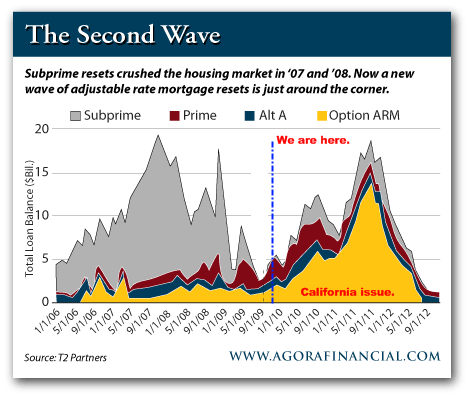
Why you shouldn't buy a house in California in 2010 (unless you're swimming in cash)
Illinois on the verge of bankruptcy.
iPhone application saves life of person trapped in Haiti earthquake rubble for 65 hours.
Best headline of the day: Scott Brown Wins Mass. Race, Giving GOP 41-59 Majority in the Senate
Jerry Brown is Governor of California again!
Why you shouldn't buy a house in California in 2010 (unless you're swimming in cash)
Illinois on the verge of bankruptcy.
January 08, 2010
BITS
Many homeowners can no longer afford their mortgage payments. That's status quo for any recession. What's new this time are those millions of homeowners who stop making affordable payments. Is this justified just because banks are screwing us over? You tell me....
Two ways to open a corked wine bottle without a corkscrew: method 1, method 2
Friday humor: kid stuck behind couch
This under-$100 gadget gives you the equivalent of a cell phone tower in your home.
Earth to be wiped out by nearby supernova! But don't panic quite yet.
Oh my.... States and local governments may face a $2 Trillion public pension deficit. From this to the federal deficit, the rising un- and underemployment levels and the ongoing residential and commercial real estate crashes, saying that this nation is in dire straits is becoming the understatement of the century.
KD Lang has pretty much the most gut-wrenchingly beautiful singing voice I've ever heard. You can listen to a sampling of her work here. Enjoy!
When I replace my Blackberry phone this year, I'm going to take a very close look at the Nexus One, Google's first offering.
Slideshow of the world's newest tallest building in Dubai.
Shopping for a home in Los Angeles County? Beware of the Shadow Inventory.
Two ways to open a corked wine bottle without a corkscrew: method 1, method 2
Friday humor: kid stuck behind couch
This under-$100 gadget gives you the equivalent of a cell phone tower in your home.
Earth to be wiped out by nearby supernova! But don't panic quite yet.
Oh my.... States and local governments may face a $2 Trillion public pension deficit. From this to the federal deficit, the rising un- and underemployment levels and the ongoing residential and commercial real estate crashes, saying that this nation is in dire straits is becoming the understatement of the century.
KD Lang has pretty much the most gut-wrenchingly beautiful singing voice I've ever heard. You can listen to a sampling of her work here. Enjoy!
When I replace my Blackberry phone this year, I'm going to take a very close look at the Nexus One, Google's first offering.
Slideshow of the world's newest tallest building in Dubai.
Shopping for a home in Los Angeles County? Beware of the Shadow Inventory.
October 23, 2009
If you're still confused by the current economy, including housing, check out this great explanation (here's the link):
US Housing Crash Continues - It's Still A Terrible Time To Buy - Falling House Prices Are The Solution, Not The Problem By Patrick Killelea, last updated Thu Oct 15, 2009 House prices will keep falling in most places because those prices are still dangerously high compared to incomes and rents. Banks say a safe mortgage is a maximum of 3 times the buyer's yearly income with 20% downpayment. Landlords say a safe price is a maximum of 15 times the house's yearly rent. Yet on the coasts, both those safety rules are still being violated. Buyers are still borrowing 6 times their income and putting only 3% down, and sellers are still asking 30 times annual rent, even after recent price declines. Renting is a cash business that reflects what people can really pay based on their salary, not how much they can borrow. Salaries and rents prove that prices will keep falling for a long time. Anyone who bought a "bargain" this time last year is already sitting on a very painful loss. It's still much cheaper to rent than to own the same size and quality house, in the same school district. On the coasts, yearly rents are less than 3% of purchase price and mortgage rates are 6%, so it costs twice as much to borrow the money than it does to borrow the house. Renters win and owners lose! Worse, total owner costs including taxes, maintenance, and insurance come to about 9% of purchase price, which is three times the cost of renting. Buying a house is still a very bad deal for the buyer on the coasts, but it does make sense to buy in the Midwest and some other places where prices have fallen into line with salaries and rents. Check whether you should rent or buy in your own area with this NY Times calculator. The bottom will be here when buying a house to rent out clearly makes money. Then you'll know it's safe to buy for yourself because then rent can cover the mortgage and all expenses if necessary, eliminating most of the risk. For a rough indication of the wisdom of buying, divide annual rent by the purchase price for the house: 3% = do not buy 6% = borderline 9% = ok to buy So for example, it's borderline to pay $200,000 for a house that would cost you $1,000 per month to rent. That's $12,000 per year in rent. If you buy it with a 6% mortgage, that's $12,000 per year in interest instead, so it works out about the same. Owners can pay interest with pre-tax money, but that benefit gets wiped out by maintenance costs and property tax, equalizing things. It is foolish to pay $400,000 for that same house, because renting it would cost you only half as much per year, and renters are completely safe from falling house prices. It's a terrible time to buy when interest rates are low, like now. Realtors just lie without shame about this fundamental fact. Prices fall as interest rates rise, because a fixed monthly payment covers a smaller mortgage at a higher interest rate. Since interest rates have nowhere to go but up, prices have nowhere to go but down. The way to win the game is to have cash on hand to buy outright at a low price when others cannot borrow very much because of high interest rates. To buy at a time of very low interest rates is a mistake. It is far better to pay a low price with a high interest rate than a high price with a low interest rate, even if the mortgage payment is the same either way. Your property taxes will be lower with a low purchase price. A low price gives you the ability to pay it all off instead of being a debt-slave forever. Paying a high price now may trap you "under water", meaning you'll have a mortgage larger than the value of the house. Then you will not be able to refinance, and won't be able to sell without a loss. Even if you get a long-term fixed rate mortgage, when rates inevitably go up the value of your property will go down. Paying a low price minimizes your damage. The US economy will not recover until interest rates are allowed to rise. To favor debtors and banks, the Federal Reserve forces artificially low interest rates on America, destroying the free market for money itself. The Fed prints up bales of money and lends it to banks at 0%, so the banks feel no need to pay you any interest for your money. While this does temporarily let debtors and banks evade the consequences of their own bad decisions, it also eliminates all investment in businesses, crippling the economy and leading to mass unemployment. Investing in business is always risky, and it's especially risky in uncertain times like now. People with money will not invest until they feel interest rates are high enough to compensate them for the risk. Investors and banks refuse to risk their money at the Fed's artificially low rates, because at those rates, they will lose money. Would you loan money to a business at 4%, when the odds of losing your money are 8%? Buyers borrowed too much money and cannot pay it back. Now there are mass foreclosures, and the Federal Reserve is buying up bad mortgages to let banks evade the consequences of their own foolish lending. Congress also authorized vast amounts of bailout cash from taxpayers, to be loaned to banks that can't even remember how to write a safe mortgage. These purchases and loans reward banks for making very bad gambles on lending. The Federal Reserve's manipulation of interest rates punishes savers (did you check CD rates lately?) and keeps debtors in the maximum amount of debt possible without default. The Federal Reserve's motto seems to be "make everyone slave away for the banks, forever". We also have legal contracts being modified to stop even well-justified foreclosures. No one was forced to borrow money. It was a choice -- a very bad choice, but completely voluntary. Grownups should be responsible for their own actions. To prevent a justified foreclosure is also to prevent a deserving family from buying that house at a low price, not to mention what this does to faith in contract law. No one in government or the media will even mention that everyone in foreclosure trouble got themselves into that spot by voluntarily borrowing money to spend on luxuries. Should taxes and artificially low interest rates and newly printed cash be used to pay the debts of irresponsible borrowers, no matter how much they over-borrowed and overpaid for a house? Should savers be forced to pay the debts of other people who cannot afford "their homes" no matter how far it is beyond their actual financial means? If so, go buy the most expensive house you can right now! Borrow as much as you possibly can to buy a bigger house, and don't pay it back, knowing that the Fed and Congress will force the real repayment obligation onto savers, onto people who are living within their means, so that you can stay in "your home" rather than in a house you can actually afford. No one ever died because they had to rent. Banks happily loaned whatever amount borrowers wanted as long as the banks could then sell the loan, pushing the default risk onto Fannie Mae (taxpayers) or onto buyers of mortgage-backed bonds. Now that it has become clear that two trillion dollars in foolish mortgage loans will not be repaid, Fannie Mae is under pressure not to buy risky loans and investors do not want mortgage-backed bonds. This means that the money available for mortgages is falling, and house prices will keep falling, probably for another five years or more. This is not just a subprime problem. All mortgages will be harder to get. A return to traditional lending standards means a return to traditional prices, which are far below current prices. Extreme use of leverage. Leverage means using debt to amplify gain. Most people forget that losses get amplified as well. If a buyer puts 10% down and the house goes down 10%, he has lost 100% of his money on paper. If he has to sell due to job loss or an interest rate hike, he's bankrupt in the real world. It's worse than that. House prices do not even have to fall to cause big losses. The cost of selling a house is 6% because of the realtor lobby's corruption of US legislators. On a $300,000 house, that's $18,000 lost even if prices just stay flat. So a 4% decline in housing prices bankrupts all those with 10% equity or less. Shortage of first-time buyers. From The Herald: "We were all corrupted by the housing boom, to some extent. People talked endlessly about how their houses were earning more than they did, never asking where all this free money was coming from. Well the truth is that it was being stolen from the next generation. Houses price increases don't produce wealth, they merely transfer it from the young to the old - from the coming generation of families who have to burden themselves with colossal debts if they want to own, to the baby boomers who are about to retire and live on the cash they make when they downsize." High house prices have been very unfair to new families, especially those with children. It is foolish for them to buy at current high prices, yet government leaders never talk about how lower house prices are good for pretty much everyone except bankers, instead preferring to sacrifice American families to make sure bankers have plenty of debt to earn interest on. If you own a house and ever want to upgrade, you benefit from falling prices because you'll save more on your next house than you'll lose in selling your current house. Every "affordability" program drives prices higher by pushing buyers deeper into debt. To really help Americans, Fannie Mae and Freddie Mac and the FHA should be completely eliminated, along with the mortgage-interest deduction. Canada has no mortgage-interest deduction at all, and has a more affordable and stable housing market because of that. Government "affordability" programs just encourage debt, making prices higher, not lower. True affordability is not more debt -- true affordability is lower prices. The government's false affordability programs have created more debt than can ever be repaid. Credit rating agencies then lied about the value of this debt, ending trust in the whole system. The government keeps house prices unaffordably high through programs that increase buyer debt, and then pretends to be interested in affordable housing. No one in government ever talks about the obvious solution: less debt and lower house prices. That solution would harm bank profits! The real result of every "affordability" program is to keep you in debt for the rest of your life so that you remain an obedient worker. Lower house prices would liberate millions of people from decades of labor each. There is never anything in the press about the millions of people that were hurt and continue to be hurt by high house prices. The government pretends to be interested in affordable housing, but now that housing is becoming affordable via falling prices, they want to stop it? Their actions speak louder than their words. The government will step in or stay out only if it helps corporate profits for congressional campaign donors. Why is the failed market in health care exempt from anti-trust laws? Because the insurance cartel makes the most profit that way, and the cartel uses that money to pay lobbyists who get congressmen to vote against change. Why is the failed market in housing propped up with taxpayer-subsidized loans? Because banks make the most profit that way, and banks use that profit to pay lobbyists who get congressmen to vote against change. It is not government itself that is the problem, but corporate control of government, using congress to forcibly extract profits from you. Deflation. There is fear of inflation, but it's not likely in the next few years. The actual amount of money created by the Fed lately is a trillion dollars, which sounds huge, but is small compared to the $10 trillion drop in housing "values" and another $10 trillion drop in stock market capitalization. The US government will not print extreme amounts of cash like Zimbabwe did, because significant inflation would mean that foreigners would no longer lend money to the US government unless interest rates were much higher to compensate them for inflation losses. Higher interest rates would push more people with adjustable mortgages into default, leading to more bank losses. So the Fed won't do it. The most likely scenario is like Japan: low inflation and low interest rates, with falling house prices for years to come. Baby boomers retiring. There are 77 million Americans born between 1946-1964. One-third have zero retirement savings. The oldest are 62. The only money they have is equity in a house, so they must sell. Huge glut of empty housing. Builders are being forced to drop prices even faster than owners. Builders have huge excess inventory that they cannot sell, and more houses are completed each day, making the housing slump worse. Failure to re-regulate finance. The Graham, Leach, Bliley Act did away with the depression-era safety constraints placed on banks. This paved the way for record profits in the finance industry and an effective takeover of the US government by large banks, which has not yet been reversed. The best summary explanation, from Business Week: "Today's housing prices are predicated on an impossible combination: the strong growth in income and asset values of a strong economy, plus the ultra-low interest rates of a weak economy. Either the economy's long-term prospects will get worse or rates will rise. In either scenario, housing will weaken." |
July 09, 2009
| "It baffles me how some people in [California] are able to put aside the Alt-A and option ARM data, the fact that the state is fiscally insolvent, the record breaking 11.5 percent unemployment, and with a straight face say “we are at a bottom.” In addition, I have read on more than one occasion on what many would consider fiscally prudent financial blogs where people pinch pennies and dollar cost average into the stock market preaching the ways of the tortoise. Yet in some cases, these people for whatever reason (i.e., wife/husband wants home, new baby, we need a pool, my cat needs his own room, etc) bought near or close to the peak in California in the mid to upper priced areas! This one simple act negates years and years of financial prudence. It baffles the mind but people aren’t robots and sometimes psychology throws a lasso around their common sense and drags them down into wonderland." - - - Dr. Housing Bubble |
May 29, 2009

January 27, 2009
California: Fell off a cliff and still falling
I have gone into painful detail regarding the California housing situation and need to reiterate that housing will not bottom in 2009. The reason I continue to beat this drum is so people don’t drink the Kool-Aid (again) and go out buying a home simply because it is half-off and you saw a kid spinning a neon colored sign. I’ve heard a few pundits going off this line of argument again and they are simply wrong. After posting an article with the dire 8.4% number from November, we got a release telling us unemployment had shot up to 9.3% in December. That number is stunning. Keep in mind that since 1976 (data from the Census) the highest unemployment rate for California was 11%. I expect us to break through that. In fact, we are already there if we calculated the number accurately. You need to remember that part-time workers looking for full-time jobs or those not working who have given up are not counted in the unemployment numbers. I know personally many people that are working one or two part-time jobs but want full-time employment. I’m sure you personally know of cases like this as well. Basically 1 out 10 people in the state is without work. What is more startling in the report is the massive amount of involuntary layoffs: What that means is in one month, California saw 166,000 people added to the unemployment lines and in one year, the number has jumped a stunning 653,000! That is simply jaw dropping. And as I expect with our current budget deficit still in shambles with a $40+ billion budget deficit for the next couple of years, and the fact that we have yet to see the massive recasts with option ARMs, the state is in for a tougher 2009. So we will break that 11% mark.But if we dig deeper into the data, we realize even more deterioration: Of the unemployed: The number leaving the workforce by choice is tiny. This is an across the board cut down in the employment sector. That is why the California 2009 forecast I put out will hold true since we’ve relied so heavily on the finance and real estate industries. What is disturbing is the growing number of those on unemployment insurance: “In related data, the EDD reported that there were 655,445 people receiving regular Those filing for unemployment insurance is skyrocketing. Some of you may be aware of this insurance but I think it is important to know what it is: “The amount for benefits available is based on the claimant’s earnings in the base period. To qualify for benefits in California, a claimant must have (1) earned at Just before leaving office, former President Bush did sign a law extending unemployment insurance by 13 weeks from the current 26 weeks. So 39 weeks or three-fourths of the year will be covered. The max anyone can receive is $450 per week in California. So let us run the numbers to see how much is going out per week: Number currently receiving unemployment insurance: 655,445 Keep in mind that unemployment insurance is financed by employer taxes who pay up to a maximum of $7,000 per year. Do you think with the bottom line being hit with many companies that some can actually afford this? Keep in mind when the extension was signed in November, many people had already started exhausting their funds. The government had to dig deeper in to its pockets, money which it doesn’t have. Japan has many lessons for us with its lost decade. It is probably more likely we will head down toward a Japan route instead of a Great Depression world if we do have a major economic calamity here. The fact that we have already sunk trillions into the economy and zombie banks and now we are on path for a major fiscal stimulus program, we can expect a sluggish next 10 years. Much of our future money is being spent right now. Maybe a lost decade is better than a major Great Depression? That seems to be our choice. Any pundit that tells you we are going to have a second half recovery needs to be banned from ever appearing on the air again. Really, do you think things will be shiny again by again by July? |
November 25, 2008
October 10, 2008
A cynical, yet reasonable, view of ongoing government bailouts of the U.S. housing market:
My friends, we are fucked. Wealthy people like John McCain are insulated from all of it. I really didn't want to spend the last couple of decades of my life (based on average life expectancy) living through The Second Great Depression. My only solution is to get rich quickly. Anyone have suggestions on how to do that? Legally?
| "....What is the point of dropping the [prime] rate when people are flat broke? This is the problem when people do not understand what mainstream America is battling with. If you watch many news stations they forget that nearly 50% of households have no 401(k) since they cannot afford one to begin with! Yet they operate under the impression that everyone is gambling in the world casino market. "Normally, a major Fed cut would have a major or at least positive impact on the market. Now, it is like spitting into the ocean. Earlier this week, I posted an article that compared the velocity of the 1929 crash to our current market. We have now surpassed the velocity of the crash during the Great Depression! From the peak in September of 1929 to September of 1939 the DOW was down 36%. From the peak in October 2007 to October 2008 we are now down 39%! But aren’t you glad that we are not officially in a recession? Otherwise things would really be bad. "No matter how you slice the market whether you look at the NASDAQ, DOW, or S & P 500 they are all getting hammered without prejudice. Can you believe that I heard some blowhard trying to blame this on the sub-prime market? Bwahahaha! Yes, let us blame poor people for crashing the most sophisticated global markets by buying inner city homes at overvalued prices. Give me a freaking break. The sub-prime problems now seem like a welcomed distraction in comparison to the credit market freeze, the credit default swap market, and now the consumerist global markets slamming on the breaks. You know why the global markets are crashing? Because people turned markets into Ponzi schemes of global proportions. Now that we have to reconcile reality with values their simply isn’t a correlation. That is why paying face value for mortgages is absurd. These places are going to fail anyway. Why give money to these criminals? "You want a novel idea? How about we raid the bank and investment accounts of CEOs complicit in this credit casino and use any money we find to fund loan workouts? We need to get this passed ASAP since those investment accounts they have are taking a beating so we want to make sure we liquidate right now in case the market goes any lower. If we wait any longer, their account might look like the 401(k) statement of many Americans. Can you believe that one contention in the bailout bill is about how much money we should give CEOs? Are you kidding? We should be talking about how much time they are going to get in the slammer not the size of their golden parachute...." |
My friends, we are fucked. Wealthy people like John McCain are insulated from all of it. I really didn't want to spend the last couple of decades of my life (based on average life expectancy) living through The Second Great Depression. My only solution is to get rich quickly. Anyone have suggestions on how to do that? Legally?
September 23, 2008
In an effort to wring every last cent from anxious investors who've already lost a significant chunk of their retirement portfolios' worth, financial advisers are now saying that the impending $700B bailout is going to stabilize the housing and stock markets, and that investors should buy, buy, buy! Gee, where have we heard that before? How about after each government intervention during the past year? Lowered prime interest rates. Rescue Bear-Stearns, rescue Fannie/Freddie, rescue AIG, and now $700B of free money for losers. And don't forget, immediately after each rescue all the experts said that, if it wasn't for the government rescue of Company XYZ, the global markets would have crashed and the planet would have dived into a financial meltdown.
Yeah, right.
Not only is the latest bailout proposal the largest in history, it's also the worst financial decision in history. We are going to give money away to companies that are in dire financial straits. It's that simple. We're "investing" our tax dollars in the very companies that were the most mismanaged and thus suffered the worst losses. Is that the way you would invest your personal savings?
And to add insult to injury, reasonably smart taxpayers like myself who stayed out of the housing market the past six years are going to suffer because the idiots in Washington feel it's necessary to give my (and my children's) money to companies and individuals who made bad financial decisions. I mean, WTF?! Be smart, get punished. Be a greedy asswipe and get rewarded. Apparently that's the new American Way.
There's probably nothing any of us can do to stop the Bush Administration and, by The Order of the Subservient Sheep, the Democratic Congress from giving away our money and, in the process, spitting in the face of our youngest and soon-to-be taxpayers who will have to carry the burden of this financial ruin for the next several decades.
Right now the Congressional Democrats are pretending to stand up to Bush by insisting on a better method of giving away that $700B, but in the end it's all the same old same old. Bush will in essence get his way as the Dems roll over and lay back down in their still-warm spots, waiting to receive and follow Bush's next demand.
Only in the U.S. government will you find success in enacting the worst possible laws while its taxpayers, after 7+ years of being ramrodded over a wrong war, worstening healthcare, increasing unemployment, a national infrastructure as tenuous as a stack of Legos, decreasing real wages, worsening climate and loss of constitutionally-backed personal rights, still take it all and go back to watching American Idol.
We are SO deserving of what we get.
{cross-posted at Daily Kos]
Yeah, right.
Not only is the latest bailout proposal the largest in history, it's also the worst financial decision in history. We are going to give money away to companies that are in dire financial straits. It's that simple. We're "investing" our tax dollars in the very companies that were the most mismanaged and thus suffered the worst losses. Is that the way you would invest your personal savings?
And to add insult to injury, reasonably smart taxpayers like myself who stayed out of the housing market the past six years are going to suffer because the idiots in Washington feel it's necessary to give my (and my children's) money to companies and individuals who made bad financial decisions. I mean, WTF?! Be smart, get punished. Be a greedy asswipe and get rewarded. Apparently that's the new American Way.
There's probably nothing any of us can do to stop the Bush Administration and, by The Order of the Subservient Sheep, the Democratic Congress from giving away our money and, in the process, spitting in the face of our youngest and soon-to-be taxpayers who will have to carry the burden of this financial ruin for the next several decades.
Right now the Congressional Democrats are pretending to stand up to Bush by insisting on a better method of giving away that $700B, but in the end it's all the same old same old. Bush will in essence get his way as the Dems roll over and lay back down in their still-warm spots, waiting to receive and follow Bush's next demand.
Only in the U.S. government will you find success in enacting the worst possible laws while its taxpayers, after 7+ years of being ramrodded over a wrong war, worstening healthcare, increasing unemployment, a national infrastructure as tenuous as a stack of Legos, decreasing real wages, worsening climate and loss of constitutionally-backed personal rights, still take it all and go back to watching American Idol.
We are SO deserving of what we get.
{cross-posted at Daily Kos]
0
comments

 Labels:
cartoon,
economy,
environment,
global warming,
health/medicine,
housing,
Mike,
recession
Labels:
cartoon,
economy,
environment,
global warming,
health/medicine,
housing,
Mike,
recession
 Labels:
cartoon,
economy,
environment,
global warming,
health/medicine,
housing,
Mike,
recession
Labels:
cartoon,
economy,
environment,
global warming,
health/medicine,
housing,
Mike,
recession
September 22, 2008
Unbridled Greed
Ohio saw what was coming, 13 months ago (follows short commercial):
Did I mention that this video was from August, 2007?
Did I mention that this video was from August, 2007?
September 20, 2008
The Prescient One
Nobody can say Obama didn't see the problems with the mortgage crisis and Wall St. coming. The man was ahead of his time.
| Obama Urges Bernanke, Paulson to Fight Foreclosures, Hold Homeownership Summit Thursday, March 22, 2007 FOR IMMEDIATE RELEASE Contact: Ben LaBolt WASHINGTON, DC -- U.S. Senator Barack Obama today sent a letter to Federal Reserve Chairman Bernanke and Treasury Secretary Paulson urging them to immediately convene a homeownership preservation summit with key stakeholders to fight foreclosures driven by growth in the subprime mortgage market. The text of the letter is below: Dear Chairman Bernanke and Secretary Paulson, There is grave concern in low-income communities about a potential coming wave of foreclosures. Because regulators are partly responsible for creating the environment that is leading to rising rates of home foreclosure in the subprime mortgage market, I urge you immediately to convene a homeownership preservation summit with leading mortgage lenders, investors, loan servicing organizations, consumer advocates, federal regulators and housing-related agencies to assess options for private sector responses to the challenge. We cannot sit on the sidelines while increasing numbers of American families face the risk of losing their homes. And while neither the government nor the private sector acting alone is capable of quickly balancing the important interests in widespread access to credit and responsible lending, both must act and act quickly. Working together, the relevant private sector entities and regulators may be best positioned for quick and targeted responses to mitigate the danger. Rampant foreclosures are in nobody’s interest, and I believe this is a case where all responsible industry players can share the objective of eliminating deceptive or abusive practices, preserving homeownership, and stabilizing housing markets. The summit should consider best practice loan marketing, underwriting, and origination practices consistent with the recent (and overdue) regulators’ Proposed Statement on Subprime Mortgage Lending. The summit participants should also evaluate options for independent loan counseling, voluntary loan restructuring, limited forbearance, and other possible workout strategies. I would also urge you to facilitate a serious conversation about the following: What standards investors should require of lenders, particularly with regard to verification of income and assets and the underwriting of borrowers based on fully indexed and fully amortized rates. How to facilitate and encourage appropriate intervention by loan servicing companies at the earliest signs of borrower difficulty. How to support independent community-based-organizations to provide counseling and work-out services to prevent foreclosure and preserve homeownership where practical. How to provide more effective information disclosure and financial education to ensure that borrowers are treated fairly and that deception is never a source of competitive advantage. How to adopt principles of fair competition that promote affordability, transparency, non-discrimination, genuine consumer value, and competitive returns. How to ensure adequate liquidity across all mortgage markets without exacerbating consumer and housing market vulnerability. Of course, the adoption of voluntary industry reforms will not preempt government action to crack down on predatory lending practices, or to style new restrictions on subprime lending or short-term post-purchase interventions in certain cases. My colleagues on the Senate Committee on Banking, Housing and Urban Affairs have held important hearings on mortgage market turmoil and I expect the Committee will develop legislation. Nevertheless, a consortium of industry-related service providers and public interest advocates may be able to bring quick and efficient relief to millions of at-risk homeowners and neighborhoods, even before Congress has had an opportunity to act. There is an opportunity here to bring different interests together in the best interests of American homeowners and the American economy. Please don’t let this opportunity pass us by. Sincerely, U.S. Senator Barack Obama |
July 18, 2008
This is the latest scam by lawyers taking advantage of debt-ridden homwowners facing foreclosure:
Yeah, right.... And of course here's the catch:
| ....While a foreclosure may seem straightforward -- a borrower doesn't pay and the bank takes back the home -- lawyers say there are numerous ways to fight. One way is forcing the lender to prove it owns the debt behind the mortgage by producing a promissory note. A mortgage is a security instrument pledging property as collateral for a loan if a borrower defaults, but it is not the promissory note itself. As mortgages were bought, bundled and sold off to investors, notes got lost in the shuffle, landing in vaults or warehouses around the country. Physically retrieving them can be difficult and sometimes impossible. About 80 percent of the time, lenders fail to attach a copy to the lawsuit, Kingcade and others said. When lenders can't prove they own the loan, lawyers can get cases dismissed, said Peter Ticktin of the Ticktin Law Group in Deerfield Beach, whose firm has advertised foreclosure defense services on television. He began taking foreclosure clients about eight months ago. So far, none of his cases have gone to trial. His clients are still in their homes. Some lawyers also ask lenders to produce all the documents in a loan file, transcripts of phone conversations with the borrower and copies of written correspondence, which can take up to a year or more to compile. Several businesses are involved, and some may have gone out of business. Kingcade said requesting and reviewing a complete file could turn up fraud or other inconsistencies leading to a successful defense, though ``the bank may be entitled to its money, and 99.9 percent of the time the bank is absolutely right.'' Neither Kingcade nor other attorneys interviewed said seeking out such documents was intended only to stall the process, which could be considered unethical.... |
Yeah, right.... And of course here's the catch:
| ....Marc Ben-Ezra, who also files foreclosures statewide for lenders, said the borrower who seeks to delay the inevitable can face consequences. Interest rates and other costs continue to pile up as the process drags on. Borrowers could be liable for the difference between what the lender recoups from the eventual home sale and the amount owed on the loan. Plus, homeowner and condo fees aren't being paid, which places hardships on people who are paying their debts. ''With every single day that goes by, they could be helping their clients get into bigger and bigger debt, rather than if they face the problems head on and resolve them as quickly as possible,'' Ben-Ezra said. |
July 10, 2008
"The Foundation of the Housing Market has Begun to Collapse"
Here's a few paragraphs to go with Mike's commentary on the economy, from Numerian at the Agonist:
| There are two really devastating events, outside of another foolhardy war, that could push the U.S. economy into a depression. The first is a dramatic increase in defaults on consumer credit card, auto, and home equity loans from prime customers, and the second is a collapse of the government sponsored enterprises that support the housing market. This week the first suggestions have begun to appear in the market that both Fannie Mae and Freddie Mac are insolvent. Since at least 2005 a number of commentators here at the Agonist have been mentioning this possibility as an important step in the collapse of the economy as the debt bubble is deflated. Back then, very few economic observers were willing to suggest such a thing, but one of them was Fed Governor William Poole. He laid out the egregious decline in credit standards that was feeding the housing bubble, and he laid blame in part on Fannie Mae and Freddie Mac. This week he stated the obvious: from an accounting standpoint, Freddie Mac is now insolvent, and Fannie Mae will be so by the end of next quarter. This means if you put a price on all their assets, there is not enough cash left over after liquidation to pay off all their liabilities. These are no longer going concerns. The stock prices of both companies tanked. Fannie Mae, the bigger of the two companies, had been trading near $70 a share this time last year. It has been steadily falling since then as the housing crisis has worsened, and today it plunged nearly 14% and closed at $13.20. Naturally, executives at these companies rushed to assert that they were healthy and sound, and one even mentioned that William Poole has for a long time been a critic of the company (kill the messenger, even though he has been right for years). Henry Paulson, Secretary of the Treasury, said the regulators for these companies assured him that they were well-capitalized. The market paid no attention. Government assurances about “well-capitalized” financial firms has lost virtually any credibility since Bear Stearns. One of the things we’ve often mentioned here is that Fannie Mae and Freddie Mac have been allowed to operate on the flimsiest amounts of capital – 2% of assets compared to 8% of assets for commercial banks. This leniency is coming home to roost. Fannie Mae has something like $30 billion in available capital to cover any losses, yet it owns hundreds of billions of mortgages on its balance sheet, and has guaranteed the performance of trillions of dollars more. This is really the point Poole is making: even a modest percentage of losses on such a huge portfolio would wipe out $30 billion in capital... |
June 09, 2008
Julian Delasantellis of Asian Times Online has a problem with the Fed's current and recent past policies concerning the prime rate (excerpt):
| "....If he's not going to cut rates to support the economy, then the only conclusion you can make regarding [US Federal Reserve chairman Ben]Bernanke's policy intentions is that he is going to cut the sinking economy free. The chairman and the board apparently intend to row away in their comfortable lifeboat as the economy around them screams and drowns. If you think that no society could be so callous as to let millions of its most vulnerable citizens suffer the harsh gales of casino capitalism's vicissitudes, you haven't been watching much American social and political debate recently. Rapidly, the subprime mortgage crisis, and the misery and heartache it is delivering to hundreds of thousands of struggling American homeowners every month, is falling from the American public's all too brief attention spans - the only endangered homeowner who gets media attention these days for his housing woes is former Johnny Carson sidekick Ed McMahon, facing imminent foreclosure on his $6 million Beverly Hills mansion. The Congressional housing foreclosure relief bill sponsored by Senator Christopher Dodd of Connecticut and Representative Barney Frank of Massachusetts is, like most Democratic Party initiatives since the party's takeover of Congress early in 2007, stalling under the weight of well-worn Republican legerdemain and obfuscation, not to mention the likely veto that awaits it from President George W Bush. Republican Senator Jim Bunning of Kentucky held up the bill to make sure that no government monies in it would go to illegal aliens, drug offenders, or sex offenders (and definitely not to someone who was simultaneously all three). Obviously, public demands for relief from the housing crisis have not yet reached a level sufficiently insistent that Republicans are going to stop pitching raw red meat into the foaming mouths of their political base, the so-called "values voters". Publicity over the housing crisis has been replaced by impotent panic over sky-high gas prices (not that the bitterly polarized Congress is going to do anything about that, either) and a new particularly American phenomenon; the abundant amount of hate, venom and vitriol pouring out from the men of God in the pulpits of the nation’s most popular and well-attended houses of worship. If I owned a business that needed a rapid US economic recovery to remain solvent, or a house that needed some price appreciation real soon to be able to be refinanced, or even a stock portfolio insufficiently hedged with ether foreign currency or foreign stock and gold holdings, I’d be looking at the events of late last week with the highest possible levels of trepidation. No salvation to these problems is likely to be seen by looking east to the Potomac, to the nation’s dysfunctional seat of government in Washington. I’d look the other way, over the Pacific, to China and the other newly and rapidly industrializing economies. Export demand from these nations is now just about the only thing keeping the American economy away from the abyss. |
Not that this is breaking news these days, but still, when 1 out of 11 mortgages are in serious trouble, you just cannot ignore it anymore. You may not have mortgage payment problems, or you may live in rent-controlled housing, but you're going to get zinged by this housing crisis, one way or the other. That subprime line on the graph below of course will eventually come back down, but the damage it's causing on its way up will take years to overcome.


March 04, 2008
"The Crash is past. Comes now Inflation."
Please, read the entire article, these are the first 2 paragraphs:
| Seems to me a lot of people don’t realize the worst financial crash since 1929 has already occurred. I suppose they are waiting for a big explosive fireball and a lot of noise like in a Hollywood movie, or for the nightly news on their wide-screen televisions to show pictures of desperate bankers and brokers splattered on the sidewalks in front of 60-story temples of finance. This diary is my humble little attempt to let these people know that the crash has already happened. It began in August. I guess they didn’t notice, but a number of financial markets have already collapsed. First, of course, there was the derivatives based on sub-prime mortgages. That seems to be about where the common consciousness stops. But before U.S. Secretary Treasury Hank Paulson and Federal Reserve Chairman Ben Bernanke (a.k.a., Captain Carnage) even lifted a finger to try and sort out the sub-prime mortgage mess, they first had to deal with the collapse of the market for Structured Investment Vehicles. Since these two crises began last summer many other financial markets have also collapsed: corporate junk bonds, asset-backed commercial paper, municipal bonds. This last was saved just last week by New York State Insurance Commissioner Dinallo basically forcing Moodys, S&P and Fitch to give AAA ratings to the monolines insurers. All these markets have pretty much ceased functioning, with not even the banks that created some of this stuff willing to buy their own product. Financial institutions have also been disappearing, especially a number of hedge funds, the most recent being this past week: Peloton, a London-based hedge fund specializing in asset-backed bonds. |
January 24, 2008

December 16, 2007
Joseph L. Galloway
| Commentary: The Disgraceful Treatment of our Veterans As you do your holiday shopping this year and think about a big turkey dinner and piles of gifts and the good life that most Americans enjoy, please spare a thought for those who made it all possible: Those who serve in our military and the veterans who've worn the uniform. There are some new statistics that give us reason to be ashamed for the way that our country has treated those who've served and sacrificed for us. Those statistics damn the politicians who start every speech by thanking the troops and veterans and blessing them. They indict our national leaders who turn up at military bases and the annual conventions of veteran's organizations and use troops and veterans as a backdrop for their photo-ops. Consider this: * An average of 18 veterans commit suicide each and every day of the year, according to recent statistics from the Veterans Administration (VA). That’s 126 veterans who kill themselves every week. Or some 6,552 who take their own lives each year. Our veterans are killing themselves at twice the rate of other Americans. * One quarter of the homeless people in America are military veterans. That’s one in every four. Is that ragged man huddled on the steam grate in a brutal winter wind a Vietnam vet? Did that younger man panhandling for pocket change on the street corner fight in Kandahar or Fallujah? For the past four years, the Department of Veterans Affairs has been insisting that it’s doing everything it needs to for the nation’s veterans. That's simply not true, particularly when it comes to the VA's treatment of mental health issues. As my McClatchy colleague Chris Adams has reported in a series of groundbreaking stories this year, the VA mental health system — even by its own measures — wasn’t prepared to give returning veterans the mental health care they need. The experts say that between 20 and 30 percent of all troops returning from combat duty in Iraq and Afghanistan may be suffering from post-traumatic stress disorder (PTSD). But many of VA hospitals didn’t have the special PTSD programs that experts say are vital. Soldiers returning from Iraq are allowed to slip unnoticed into their old lives, and neither the Department of Defense nor the VA does anything to monitor their mental health. The VA keeps telling Congress that all is well. That's not true, either. As Adams reported, the VA has been using fudged or inflated numbers to do so. And after years of promising that it's getting a growing backlog of disability compensation applications under control, things actually got worse this year. No matter whether they've been wounded and need follow-up care and support, or whether they're coming apart at the seams and feeling suicidal, they sometimes must wait months for an appointment to be evaluated and treated at VA medical centers. The same people who don’t blink at spending $3 billion a week on their war of choice in Iraq were the ones who cut the VA budget and privatized maintenance at Walter Reed Army Hospital and opposed every attempt to expand benefits for veterans old and young. They're the same people who turned a blind eye as their corporate sponsors and private donors looted billions of dollars from the Treasury with no-compete contracts and bloated bills for everything from food for the troops to fuel for their tanks and trucks. As a wave of wounded troops suffering brain injuries from the blasts of roadside bombs and landmines poured into military hospitals, these people, posing as fiscally responsible budget makers, were cutting in half the money spent on research into brain injuries. These frauds who love to pose as wartime leaders sat back and did nothing as a cruel bureaucracy sent bill collectors out to harass double amputee veterans for thousands of dollars because they neglected to turn their armored vests and other gear in to the supply sergeant after they were blown apart on the battlefield. They did nothing as the Army became ever more conservative, even stingy, in the number of injured and wounded soldiers it judged worthy of full disability pensions. Soldiers who suffered brain injuries and PTSD so severe that they couldn't function were put on the street with a 30 percent disability pension — $700 a month — to support a wife and three children. Neglecting our war veterans and the widows and orphans that result from our wars is as American as apple pie. It’s nothing new. But in the past we always waited until after the war’s end to forget those who'd fought the war. This may be the first time in our history that we began to neglect and forget our troops during a war. All of this is shameful — shameful for a people whose freedom and prosperity rests on the backs of those soldiers but who've forgotten them so completely that they haven't held their Congress and their president responsible for this stain on our honor. The next smarmy politician who shouts, “God bless our troops” ought to be tarred and feathered and ridden out of Washington on a rail for sheer hypocrisy. - Joseph L. Galloway / McClatchy Newspapers |
September 03, 2007
Healthcare for the Veteran: bu$h'$ Top Priority?
Here's part of pResident bu$h'$ VFW speech:
I understand what a contradiction is. But to have "Heckuva Job Jimmy" Nicholson come out and lobby congress for less money for Veterans is just plain despicable. In addition he threatens congress, "...that time is short to avoid disruption in veterans’ programs."
Please Jim, don't let the door hit you on the ass too soon!!
OK, so my eyes are deceiving me, right! bu$h promised: "...in this budget I submitted there's $87 billion for the veterans..."
Yet, "Nicholson asked lawmakers to resist adding more money to the $39.4 billion requested by President Bush." If my math skills are still intact, that would mean the budget bu$h promised in his VFW speech has suddenly shrunk by 55%! It still sounds like the Veteran is getting the short end of the stick. And bu$h'$ rhetoric to the VFW was just that, rhetoric.
Finally, bu$h made the statement, "We agree our homeless vets ought to have shelter, and that's what we're providing."
bu$h, have you thought, that no United States Veteran should be homeless, hungry, without money or proper medical care...ever?
Nothing is more shameful for our country to endure! These brave soldiers go off to defend their country, serve their patriotic duty, be used as photo props, and have them end up sick, injured and homeless!
Shame on you bu$h, shame on you Nicholson! No amount of money will be enough!
| But here's what we do agree on: We agree our veterans deserve the full support of the United States government. (Applause.) That's why in this budget I submitted there's $87 billion for the veterans; it's the highest level of support ever for the veterans in American history. (Applause.) We agree that health care for our veterans is a top priority, and that's why we've increased health care spending for our veterans by 83 percent since I was sworn in as your President. (Applause.) We agree that a troop coming out of Iraq or Afghanistan deserves the best health care not only as an active duty citizen, but as a military guy, but also as a veteran -- and you're going to get the best health care we can possibly provide. (Applause.) We agree our homeless vets ought to have shelter, and that's what we're providing. In other words, we agree the veterans deserve the full support of our government and that's what you're going to get as George W. Bush as your President. (Applause.) |
I understand what a contradiction is. But to have "Heckuva Job Jimmy" Nicholson come out and lobby congress for less money for Veterans is just plain despicable. In addition he threatens congress, "...that time is short to avoid disruption in veterans’ programs."
Please Jim, don't let the door hit you on the ass too soon!!
The Department of Veterans Affairs does not need more money; it just needs a budget to quickly pass Congress, VA Secretary Jim Nicholson said in a letter to key lawmakers. Passing a funding bill by the start of the fiscal year, which begins Oct. 1, “is essential” to avoid the problems that would result from operating under a temporary budget, where spending is capped and new programs cannot be started. |
OK, so my eyes are deceiving me, right! bu$h promised: "...in this budget I submitted there's $87 billion for the veterans..."
Yet, "Nicholson asked lawmakers to resist adding more money to the $39.4 billion requested by President Bush." If my math skills are still intact, that would mean the budget bu$h promised in his VFW speech has suddenly shrunk by 55%! It still sounds like the Veteran is getting the short end of the stick. And bu$h'$ rhetoric to the VFW was just that, rhetoric.
Finally, bu$h made the statement, "We agree our homeless vets ought to have shelter, and that's what we're providing."
| Federal government surveys show that one-third of adult homeless men and nearly one-quarter of all homeless adults across the country have served in the armed forces. The ratio of veterans among the homeless is the same in Massachusetts, according to research by the joint legislative committee. The Bedford center is one of only two in the state run by the federal government for veterans; the other is in Brockton. Other homeless shelters -- some exclusively for veterans, others not -- are run privately or by the state. |
bu$h, have you thought, that no United States Veteran should be homeless, hungry, without money or proper medical care...ever?
Nothing is more shameful for our country to endure! These brave soldiers go off to defend their country, serve their patriotic duty, be used as photo props, and have them end up sick, injured and homeless!
Shame on you bu$h, shame on you Nicholson! No amount of money will be enough!
Subscribe to:
Posts (Atom)


